Monday, 1 April 2013


My last blog post…hopefully ever. For the final one, I wanted to do an ‘in the news’ special. Exciting right…. Anyways I came across an article in the Times Colonist (March 15, 2013) about the discovery of thirteen bodies in London, thought to be Black Plague victims. The bodies were uncovered in the process of the giant rail-line they want to build across London (because apparently British people don’t own cars…or have busses). The remains were laid out in an orderly fashion suggesting a graveyard; also there was a record of it so that couldn't have a hard conclusion to arrive at, on the edge of a historic square. This tends to take my thoughts back to my last post about the ethics of such a thing as disturbing human remains. They obviously had some idea that there was a historic gravesite so couldn't they have moved their snazzy rail-line ten feet over? For some vague reason the answer is usually no. They are intending to excavate and do scientific analyses on the bodies in order to discover if they were indeed victims of the plague which decimated the city in the 14th century, in addition to pretty much everywhere else. A lot of other neat things have been found in the construction of this major project and this seems to me to be the new way of archaeology. No more Indian Jones running around discovering new and exciting finds through adventure and intuition…now it’s a phone call from Joe Blow construction man who just dug up some stuff and you gotta get it out fast so he can get back to whatever construction workers do when they’re not standing in a circle smoking.
Which is a bit sad to me but I guess that’s progress, now that I think about it I’m not exactly sure what I though would happen when I got a job but it was a more romantic notion then the reality that’s for sure. But really it’s all pretty awesome so I’ll take what I can get, even if it is archaeology in the middle of a city… I don’t like cities though and I hope I never have to go to London. That being said this is a pretty cool find and if they can find out some information about the lives of these people and the context in which they died it would be a neat thing for the people of London with long family ties to the area. Seeing as they keep disturbing cool stuff underground incorporating that into the general theme of the rail-line might be an interesting idea. At least an information plaque or something I'm sure would be appreciated by the people of London and their tourists, and as I've said before public dissemination all the way!

http://www.timescolonist.com/news/world/construction-workers-find-burial-ground-in-london-that-may-contain-black-plague-victims-1.91711

Wednesday, 27 March 2013

 Ethics in Archaeology?

So I was planning on doing a blog entry about ethics and these last two classes have fit in really well with what I was planning on saying. Ethics in archaeology is something that really concerns me; none more so than with the handling and treatment of human remains. In one of our required reading articles, Who Owns the Past? by V. Morell, I was quite shocked and upset by what I was reading. I know that repatriation and the treatment of human remain is a contentious issue in archaeology and bioarchaeology and really any discipline which has to deal with them and I also know that I have some very strong feelings about what I consider to be right and wrong surrounding this issue. First of all, in this article what I notice is a bunch of archaeologists being way too melodramatic; just because the study of human remains could be limited does not mean “The end of anthropology” (p.1424). These people are very limited in their scope of the discipline if they think that the only thing any anthropologist is concerned about is human bones. I do agree though, that the study of human remains is immensely important and can shed light on past practices, migrations and lifeway’s in the way that little other evidence can. But I also think that descendent groups deserve the right to approve or disapprove any research being conducted on their ancestors. “Across the globe, archaeologists and anthropologists are making the unhappy discovery that governments are giving cultural traditions and religious beliefs higher priority than scientific inquiry.” (Morell, 1995:1424). This quote from the article gave me shivers; in the case of archaeology when working with descendent groups, I personally believe that ‘cultural traditions’ damn well have every right over ‘scientific inquiry’ according to an archaeologist. For the most part, I find, that archaeologists are not members of the indigenous community where they are working and so when they put their own research above the feelings and traditions of those groups they do so without acknowledging what it may mean to those people. Scientific study and its importance is something which has been made up by modern Western scholars and, although I believe full heartedly in science, I do not think it has any precedence over any other cultural tradition.
In the case of Australia, the indigenous aboriginal inhabitants have long faced many struggles with the colonizing governments, much the same way as the first peoples of Canada have, and so when I see articles like the ones we had to read it makes me cringe a little. These people have undergone immense hardships and disrespect, not only at the hands of the government, but also from those early looters who called themselves ‘archaeologists’ and seeing things like those articles is not going to make indigenous groups any more eager to work with archaeologists in the future. And that is where I think we can sort all this out; by establishing proper respectful, working relationships with the peoples whose history we’re researching because if we aren’t then I really don’t see any point. The reason I went to school to become an archaeologist is because I think the past is important to people and can benefit them in term of cultural maintenance and land rights issues and that is why I will do whatever job it is I hopefully one day get (fingers crossed). If archaeology is not accessible to the public, most importantly those member of the public who the research directly connects with, then what is the point? So a bunch of academics can get together and brag about what new thing they found that no one in the public will hear about, let alone be able to decipher through all the scholarly jargon we use. That just doesn’t seem worth it to me, public dissemination should be a major part of any archaeological research, not just the ones dealing with human remains and indigenous groups should be consulted from the very beginning. Maybe this is me being sentimental because the thought of some rude archaeologist digging up my bones, studying me under a cold light and then packing me away in some dark museum basement gives me the creeps but I think it’s also just a matter of what I think is right and fair when dealing with sensitive material and the people to whom this material rightly belongs.
Morell, Virginia
      1995 Who Owns the Past? Science, New Series 268(5216):1424-1426.

Thursday, 21 March 2013


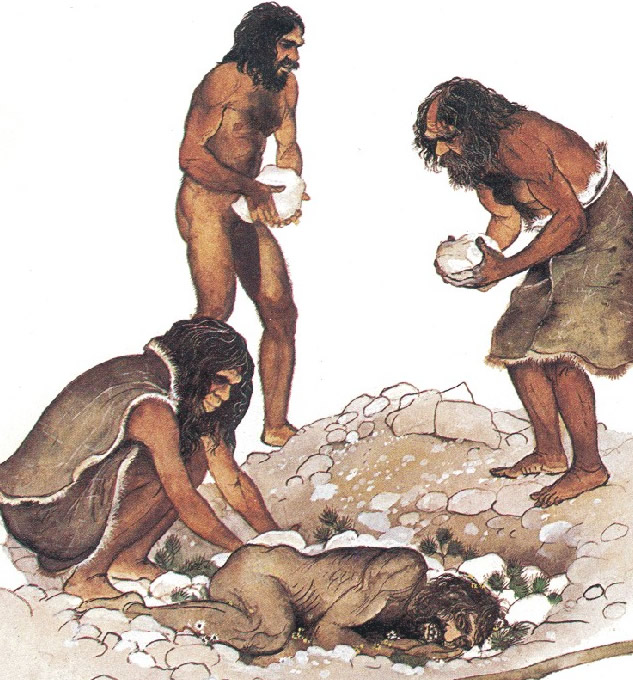
       In a paper for another class I’m looking into the origins of burial, which I thought would apply here pretty nicely. I posted about a site a while ago; Sima De Los Huesos in Spain, a cave site all full of youngish hominins possibly Neandertals possibly H. habilis. All these poor guys are basically piled in a sector of this cave and so people are thinking that this is an example of symbolic funerary behaviour. Now from my point of view I think I would be hesitant to chuck Great Uncle Joe and the other 40 people who died that day into a giant hole underground…seems a bit odd to me, but I was brought up in a culture with very strict, very formal, very ritualized funerary practices. And really whos to know what those ancient hominins who aren’t event he same species were thinking about their dead. I think it is pretty widely accepted that Neandertals had culture in one form or another, especially in the later periods of their existence. It is also accepted that they had formal burials for at least some of their people. Neandertals utilized the same tools as modern humans, exhibited complex thought patterns, most likely had speech and fashioned personal ornaments. Now when I look at all these qualifications of the Neandertals I think why not could they have had ritualized burials, I’m sure they were capable of it. But then again I’m capable of running down my street in a clown suit singing the national anthem…but I’m not going to. So, I think we need to be very careful when attempting to subscribe modern human behaviours to these ancient beings. The literature seems to vary between being very cautious about ascribing any kind of ritual behaviour to the ones who seem to be certain that Neandertals were very much like us and practised all sorts of fun symbolic things.
       What I have found is that pretty much all of the super interesting sites which would represent cool symbolic behaviour have been proved to be false. Take the Neandertal cave bear cult of Drachenloch Cave with all the stone structures full of cave bear skulls. Now this would have been an amazing find and truly attest to a ritualistic even spiritual aspect to the Neandertals. But again this site has been discredited by shoddy excavation, badly kept records and contradictory statements about the site by the principle investigator. In addition modern archaeologists have found that taphonomy could be responsible for pretty much all of the ‘ritually’ placed cave bear skulls and so called stone structures. So from this we can see how easily one might mistake natural processes for human produced ones. I think that the origins of burial probably will remain pretty cloudy until more conclusive sites are found or the time machine is invented…which would be awesome. 

Sunday, 3 March 2013

Did we invent cannabalism?

Today I was working on a discussion for my Neandertal class about whether Neandertals were engaging in cannibalism and while I'm pretty sick of picturing people going at each other for dinner I thought it would make a relevant blog post. Finding a practice such as cannibalism in the archaeological record is tough, I think this is evidenced by the fact that there is no unequivocal example of cannibalism in the archaeological record. There are tons of papers on it though, either claiming to have a site with evidence of it or telling these people that they're wrong. I'm not exactly sure why it seems we want to find this in our past so bad; for obvious reasons cannibalism is usually looked at in a negative light. In the case of the Caribs of the Caribbean region, Europeans used accusations of cannibalism in order to justify the murder and exploitation of these people...who were never really cannibals at all. Which is why I find it fascinating that people find cannibalism so fascinating. While trying to track down the articles I had to read for my discussion, I came across many, many others talking about cannibalism in an archaeological light. As I've mentioned for almost all of these papers there is another to criticize it and give alternative, just as likely, explanations for the assemblages. People look at things like; cut marks, burning, disassociation of bones among many other lines of evidence to distinguish 'cannibalistic' remains; though cannibalism has never been a completely accepted practice.
In almost all societies there is a taboo against cannibalism, this is most likely a result of the obvious health issues involved, there is no way I'd eat something as disgusting as a human being, and when it is practised is is usually the result of either survival practices or some sort of ritual practice which is partaken of only at specific times, often only by specific people (ex. warriors, shaman, ect.). And because archaeologists are so keen on using modern ethnographic comparisons to project onto past populations, sometimes of a different species ie Neandertals, it is again curious to me that with the lack of evidence for cannibalism among modern populations, researchers insist on trying to find evidence of this in the archaeological record. I almost think its like the train wreck that you can't look away from; cannibalism is something terrible and so against what our society thinks is 'right' or 'moral' that people find it so intriguing and want to find out who and why someone would engage in this type of activity. Overall I find it pretty gross and would be perfectly happy to think that it doesn't exist at all but with all things in archaeology you never really know and cannot project ideals of our present ideas of what is normal behaviour or what should be.

Wednesday, 27 February 2013

Wow. I wish that was all I could say about this 'gay caveman' idea. I read about seven of the newpaper articles that dealt with the issue and it was pretty ridiculous. Either they just took what the archaeologist said about the man being buried the 'wrong' way and so was gay (which is kind of really stupid) and ran with it or they actually talked to someone in the field who told them it was probably a bit of a stretch. As I'm sure everyone can tell I'm on the side that thinks they're goign a bit far without a proper amount of data. I ahven't read any peer reviewed pubished work on the topic by the original archaeologists and would like to becuase in the newpaper articles a lot of information is missing. First of all how aure are they that these skeletal remains are indeed male? From a picture they looked relatively complete but as Erin mentioned in class, sexing of skeletons is on a sliding scale. Also she gives no data onto how many graves she is comparing this with if; it is an anomally out of a few thousand graves it could be interesting but even out of a hundred not so much. Also a big one for me as I'm taking evolutionary archeaology classes is that an agricultural community is not cavemen! Everytime they mention the 'caveman' bit it makes me cringe, I was hoping even the popular media would be able to tell the difference between pre H. sapiens and ancient farming community of very modern looking and acting human beings. Which brings me to the idea of the 'gay' caveman, the concept of 'gay' is a completley made up cultural phenomenon which easily could not have existed in the Corded ware culture that this person was a part of. The researchers are projecting thier own ideas of what a 'normal' man or woman should be buried like and if they aren't then what this means. There are many places in the world in which a man or woman can take on roles of that of the opposite sex while not becoming a different gender or 'gay'. Sexual preference, which is what the term 'gay' implies in Western culture, is not represented at all in this burial and so I feel this term is inappropriate to describe this man. While this burial is interesting it is definitly not the only one of its kind in the world and without more data and information on the subject I feel it is impossible to make the kind of claims that the researchers are making.
Also in Western socitey homophobia is a huge probelm which needs to be addressed and calling this individual a 'gay caveman' just beacuse he was treated in an unusual way could produce big issues in a field which has already had too much prejudice throughout its history.

Tuesday, 19 February 2013

        
Sima de los Huesos; the earliest funerary behaviour?

          For one of my other classes I was looking into an interesting site in Spain that got me thinking. The site is Sima De Los Huesos and it is a cave site associated with H. heidelbergensis. Sima consistsof 28 individuals all under the age of 30, with one young child, adolescents, and young adults which compromises 80% of the Middle Pleistocene specimens ever found including a complete range of skeletal parts from the harder more durable bones to rare, soft bones like the hyoid and inner ear bones.  In addition to the hominid remains, which are all located in a continuous depositional context; there are remains of multiple carnivores including foxes, wolves and a very large number of bear specimens. The fact that there are only carnivore faunal remains at this site rather then herbivores and an absences of any materials indicating an occupation site leads some to believe that Sima could represent the earliest evidence of mortuary practices in the world. The age profile of the deceased as well does not indicate a natural occurrence but rather a cultural one.The site is dated to 400 kya which is abotu 300 ky before any other conclusive evidence of intentional burial.
         Another fact which makes this site extremely intriguing is the presence of a single quartzite handaxe associated with the bodies. The handaxe is the poster child of the Acheulean tradition and there exact purpose and use is still debated among many researchers. The one in Sima is a fairly nice representation; it is finely flaked and made of a material not common in handaxe manufacture from the time or area. This tool may have been accidentally introduced into the deposit but may have been symbolically introduced possibly being the first ever representation of grave goods.
Sima De Los Huesos handaxe


Overall when I look at this site I am not sure what to make of it but lean towards a non-symbolic stance. The remains are all just kind of dumped within the cave and I feel may have happened to end up like this as a result of taphonomic process. There have also been a few papers coming out recently which basically shut down all of the possible 'ritual' behaviour people have been mentioning with regards to this site. Given the sorts of burials we find in the Upper Paleolithic and then comparing those with what we see in Sima de los Huesos, it makes the argument for purposeful burial here look even less valid. There is a general lack of grave goods; specific body orientation and placement and structered symbolic space among many others. I think that the biggest issue in this debate needs to be taphonomy; the site meends ot be able to live up to examination in the context of taphonomy and if it can then still appear anthropogenic in nature it will be much easier to accept. There are though, still many researchers who belive that this site is a symbolic example of formal funerary behaviour, and wouldn't that be awesome if it was? In class we have learned about different funerary practices through time and space but where do they begin and why? Sima could possibly be the first instance of intentional possibly ritualized burial known and if it is it would be especially interesting considering it is associated with an early hominin species, H. Heidelbergensis.

Carbonell, E., & Mosquera, M. (2006). The emergence of a symbolic behaviour: the sepulchral pit of Sima de los Huesos, Sierra de Atapuerca, Burgos, Spain. Comptes Rendus Palevol, 5(1/2), 155-160.


Friday, 15 February 2013

So after some immense technical difficulties I finally figured out how to post! you have to actually log in to your account...yes I know embarrassing but here are some of my backlogged posts coming at you in the next few days starting with one I wrote about 2 and half weeks ago and which went into the blue instead of onto my blog :/

This week I was thinking about death and jobs. My sister is going to school to become a police officer and my Mum is always commenting  on how its a dangerous profession and she better not die soon ect. ect. But really, what does it matter? Is there any need to connect death with a concrete thing like a career, when anyone can die at any time for any reason? I think connecting death to certain types of danger, such as a scary job, is a way for people to feel like death is something they can predict or somehow prevent. In our weird Western culture we seem to think we can control all sorts of stuff that we really can't (or shouldn't), nature being a big one with imported plants being only the first step in a crazy attempt to control the mostly uncontrollable. But I really see this aspect of control everywhere in Western society and I think we definitely extend it to the processes surrounding death. From elaborate structured funerals to appropriate mourning wear (like the Victorian example Erin mentioned in class today of actual time periods set apart for the wearing of certain colours by widows and the like) there is a proper way of conducting the processes of death and for the most part people adhere to this. Even funeral homes and cemeteries fit into this, at certain places they restrict the size and shape of your monument, what you can put on it and where you can put it. I feel that this attempt to portray a certain amount of control over something which is ultimately out of anybody's control (minus murders and stuff, and even this if one believes in fate) is because we're scared. Death in this culture is a scary thing, it is not something many people are comfortable with, at least as far as I've encountered, and what people fear or don't understand they try to control. Its an interesting thing to think about when discussing funerary practices cross culturally and how societies with different ideas to ours might differ in their practices surrounding death, which may not be any less important to them but only with less need for structured input from those survivors. 

I  also wonder what other cultures which are possibly more comfortable with the thought of death, feel about danger and if they directly connect that with the idea of death. Also how might a profession represent itself in archaeology, I know we see tools and such and connect it with possible occupations for the interred and I wonder what that might look like these days; a trowel with a former archaeologist maybe, but what about like a mime or a clown or something like that; every person buried in a suit can't be a business man right? 

Saturday, 26 January 2013

So our blog prompt for this week was about what sorts of grave goods we would like included with us in the event of our demise. I'm one of those people who are terrified of my own death so this was a bit uncomfortable for me but here's what I came up with. The things I would take for selfish reasons (if I thought they would actually come along with me into the 'afterlife') would be; some nice comfortable clothes, warm ones especially; some sort of weapon maybe you never know where you're going to end up; my dog (after a completely natural death, no sacrifices for me thanks) need a reliable pal on this new journey; my camera because there'd probably be lots of cool stuff to look at; some snacks; and a handbook of how to be dead (Beetle Juice style, I'm guessing there'll be some adjustment time).
On the other hand if some rude archaeologist was going to dig me up in the future, I might want them to find this kind of stuff which I feel might represent me well; my academic certificates, I'm very proud of my education; the first trowel I used on an actual dig; my paints, I'm not the best but I am passionate about painting; a few key pieces of jewellery, I have a lot but there are some things that were passed down to me and have a ton of sentimental value; a photo album, my family, friends and happiest memories would be here, they would know that I'm more than just bones, I loved and was loved. And that's pretty much about it, don't know if this counts but I would also like to buried near those I love, I feel better thinking about my eventual grave if it's close to people who mean a lot to me.
That said here's hoping they discover the fountain of youth before I kick it. 

Sunday, 13 January 2013

Hey guys,
So I was at work today and this lady came in with her young (probably 7-8ish) daughter, the Mum asked how my holiday's were and I asked her, the little girl chimed in that hers was great because she got a fish tank. I asked her how many fish she got and she looked up at her Mum who then nodded at her, before answering that she got five but four has died so she had two left (there's some awesome little kid math for ya). I gave my sympathies and as they were walking away I heard her Mum say, you can tell people about the dead fish just not younger kids. I found this very interesting and it sparked some thoughts about how our society really does try to shelter the young from death for as long as possible. When I was young I was never allowed to go to funerals and that silly lie all parents tell their kids about how their dog, cat, bird.... went away to live on a farm when really it had died. I'm sure not all societies are like this and its interesting to think about cultural reasons for the attempt to remove children from the dead and how this represents itself in funerary practices.

Monday, 7 January 2013

Hey everyone,
I'm Krystal, a fourth year student majoring in Anthropology. My main interest lies in archaeology and I spent the summer of 2011 in Belize on an archaeology field school. During my time at Camosun I was in a field assistant program identifying and recording burial cairns which sparked my interest in funerary archaeology.
I'm also absolutely terrible with technology especially computers (before today I had never even seen a blog before) so please excuse any issues I'll probably be having.
Cheers,
Krystal